

单主模型
环境四个虚拟机
upstream server:node1:172.16.100.6 CeotOS 6
upstream server:node3:172.16.100.69 CeotOS 7
节点1:172.16.100.67 CeotOS 7
节点2:node2:172.16.100.68 CeotOS 7
节1&2
# yum install nginx -y

# cd /etc/nginx

# vim nginx.conf

                      include /etc/nginx/conf.d/*.conf;
                      upstream webservers {
                                           server 172.16.100.6:80 weight=1;
                                           server 172.16.100.69:80 weight=1;
                       }

                     location   /   {

                                           proxy_pass   http://websrvers/;

                     }

# nginx   -t

# systemctl start nginx.service
# netstat -tnlp
用浏览器访问172.16.100.67
# scp nginx.conf node2:/etc/nginx/

节2
# systemctl start nginx.service
# netstat -tnlp
用浏览器访问172.16.100.68看能否负载均衡
- 用keepalived监控nginx服务
节1&节2
# vim keepalived.conf
     vrrp_script chk_nginx {
             script "killall -0 nginx &> /dev/null"
             interval 1
             weight -10
       }
       vrrp_instance VI_1 {
             track_script {
                   chk_nginx
             }
       }
节1
# systemctl status nginx.service
# systemctl start keepalived.service ssh node2:systemctl start keepalived.service
# systemctl status keepalived.service
# ip addr list
如果没启动起来,可能是组播地址和虚拟地址的问题,修改一下即可
宕掉nginx,肯是否会转到节点2上
# systemctl stop nginx.service
# systemctl status nginx
节2
# ip addr list
节1
# systemctl start nginx.service
浏览器访问172.16.100.88
节1(主节点)只要在线,节2(备节点)就抢不走,除非节1宕掉
# vim notify

 #!/bin/bash

 #


 vip=172.16.100.88

 contact='root@localhost'


 notify() {

 mailsubject="`hostname` to be $1: $vip floating"

 mailbody="`date '+%F %H:%M:%S'`: vrrp transition, `hostname` changed to be $1"

echo $mailbody | mail -s "$mailsubject" $contact

 }


 case "$1" in

           master)

              notify master
              systemctl restart nginx.service

              exit 0

           ;;

           backup)

               notify backup
               systemctl restart nginx.service

               exit 0

           ;;

           fault)

               notify fault

                exit 0

           ;;

           *)

               echo 'Usage: `basename $0` {master|backup|fault}'

               exit 1

            ;;

  esac
# scp notify.sh node2:/etc/keepalived/
# systemctl status keepalived
# ip addr list
主停掉,备也停掉,会自动启动nginx
# systemctl stop httpd.server
节2
# systemctl stop nginx.service
# systemctl status keepalived
节1
# systemctl status nginx.service
# systemctl status keepalived

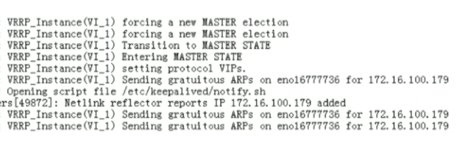
双主模型
节1
# vim keepalived.conf
            vrrp_instance VI_2 {

                        state BACKUP
                        interface ens33

                        virtual_router_id 61

                        priority 99

                        advert_int 1

                        authentication {

                                 auth_type PASS
auth_pass 1111
                       }

                       virtual_ipaddress {

                                172.16.100.180/16 dev ens33 label ens33:2

                       }
                       track_script {

                                      chk_nginx

                       }

                        notify_master “/etc/keepalived/notify.sh master”   (不手动启动nginx,而让监控系统确保nginx在线)

                        notify_backup “/etc/keepalived/notify.sh backup”

                        notify_fault “/etc/keepalived/notify.sh fault”

             }
节1&节2
(不手动启动nginx,而让监控系统确保nginx在线)
# vim notify.sh
   注释掉systemctl restart nginx.service
节2
# vim keepalived.conf
        vrrp_instance VI_2 {

                        state MASTER
                        interface ens33

                        virtual_router_id 61

                        priority 100

                        advert_int 1
                        authentication {

                                 auth_type PASS
auth_pass 1111
                       }

                       virtual_ipaddress {

                                172.16.100.180/16 dev ens33 label ens33:2

                       }
track_script {
chk_nginx
}
notify_master “/etc/keepalived/notify.sh master”
notify_backup “/etc/keepalived/notify.sh backup”
notify_fault “/etc/keepalived/notify.sh fault”
}
节1
# sytemctl restart keepalived.service; ssh node2'sytemctl restart keepalived.service'
# systemctl status keepalived

# ifconfig ens33:1 down
# sytemctl restart keepalived.service; ssh node2'sytemctl restart keepalived.service'
# systemctl status keepalived

 节2
# systemctl status keepalived.service
# ip addr list
用浏览器访问两个地址,看调度是否有问题
节1
# sytemctl restart keepalived.service; sytemctl start httpd.service
# systemctl status keepalived
节2
# systemctl status keepalived.service
# ip addr list
用浏览器访问两个地址,看调度是否有问题
节1
# sytemctl restart keepalived.service; sytemctl start httpd.service
# systemctl status keepalived
 节2
# ifconfig
节1
# sytemctl stop httpd.service; sytemctl restart nginx.service'
# systemctl status nginx.service
节2
# ifconfig
节1
# sytemctl stop httpd.service; sytemctl restart nginx.service'
# systemctl status nginx.service


# systemctl status keepalived
 # ifconfig

原创文章,作者:nene,如若转载,请注明出处:http://www.178linux.com/88155